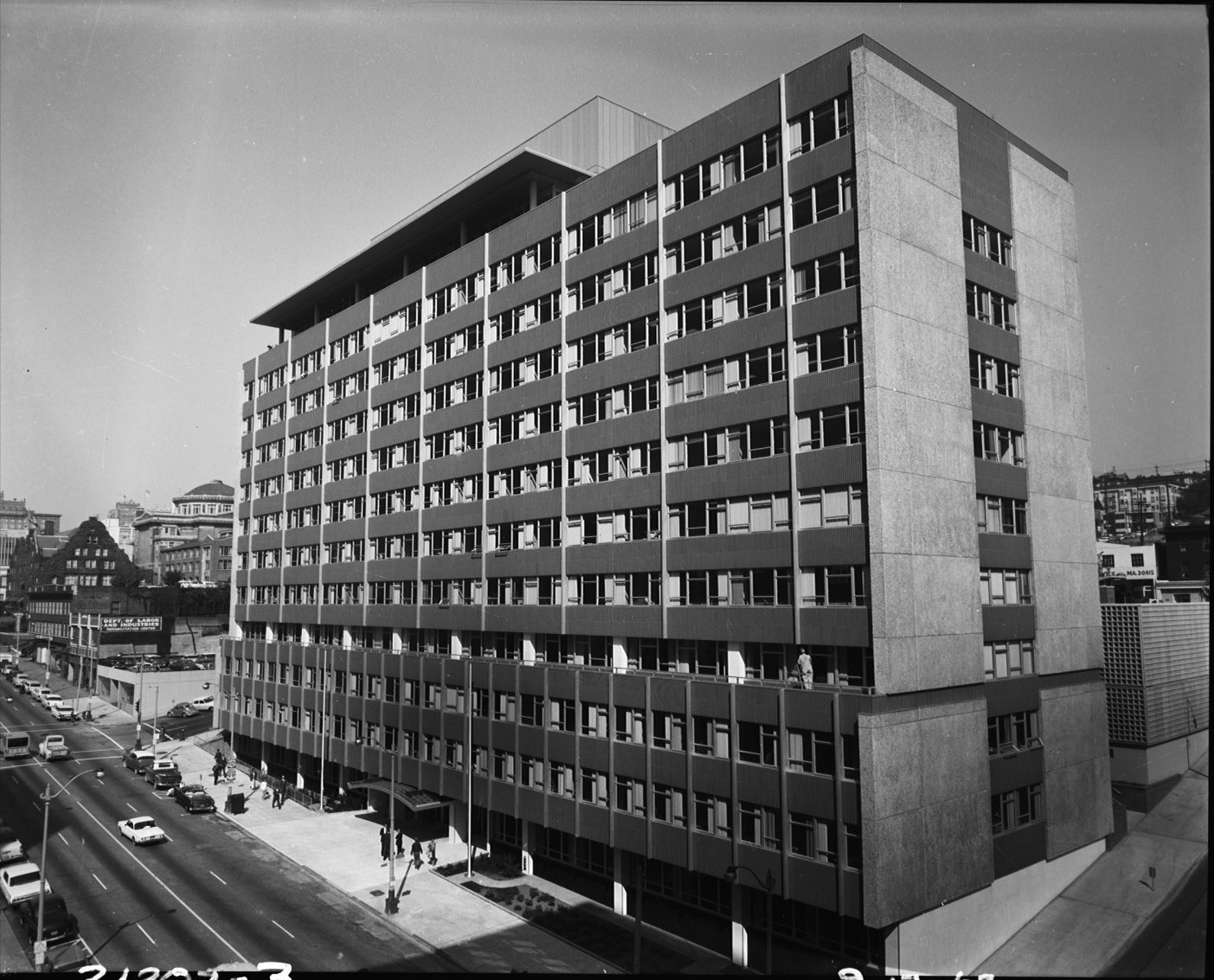
 Courtesy of Seattle Municipal Archives (73517): Many of today's court employees, including Lynn M. and Tracie C., began their careers in the City of Seattle's former Public Safety Building.
 This post is the second in a 12-part series called “From the Archives” which explores different themes in the court’s history—highlighting how the work, the people, and the spaces have evolved over time. Click here to read part one.
What the Work Looked Like
Before digital case systems, court operations at Seattle Municipal Court (SMC) ran on paper, movement, and coordination.

Two long-term employees have seen that evolution firsthand. Tracie C., now in Court Tech (IT), began as a cashier in September 1985. Lynn M. has served as a bailiff since July 1978.
Same institution. Different starting points. A shared view of how the work has changed.
Day to day, the work was physical.
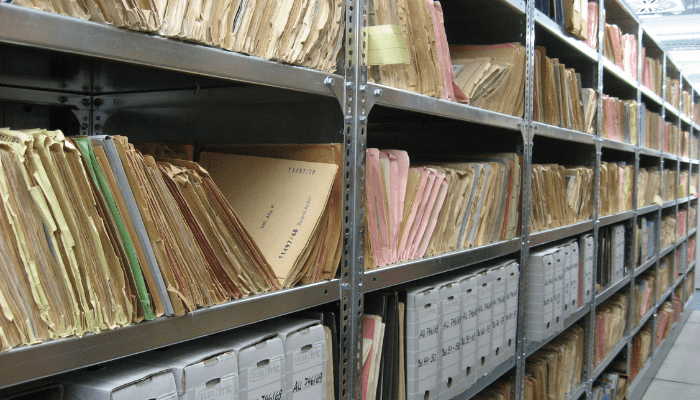
Case files were rectangular-sized folders made of fabric filled with tickets, receipts, envelopes, and handwritten notes. Nothing was discarded. Payments arrived by mail in stacks, were opened and processed by hand, and attached to case records that were later archived.
Finding information meant going to get it. Staff walked to file rooms, pulled records, and carried them where they were needed.
Even routine tasks relied on movement. In the old Public Safety Building, a pressurized tube system carried payment instructions from magistrates to cashier windows. Staff entered the information into terminals, processed payments, and sent confirmations back.
It worked—but only because people kept it moving.
Limited Systems
Technology existed, but in pieces.
Staff used black-screen terminals like MCIS, but information from other agencies, such as the Department of Licensing, required a separate, shared terminal elsewhere in the building. Staff left their stations, looked up information, and returned.
There was no email. No shared platforms. No real-time coordination.
Work was local, sequential, and dependent on presence.
The Human Work Behind It
Much of the work was written—literally.
Staff documented transactions and adjudications by hand. In the courtroom, bailiffs used carbon copy paper to record outcomes, creating multiple copies at once. Shorthand codes, such as “H” for good behavior and “K” for restitution, kept things moving but relied on shared understanding.
Bailiffs also served as a critical link between the courtroom and the public. After a judge issued a ruling, they explained next steps, whether someone needed to make a payment, check in with probation, or take another action.
Without digital prompts, this depended on clear communication and direct interaction.
The pace of work reflected that same approach. The workday didn’t end at a set time—it ended when everyone in the building had been served.
Coordination, Up Close
Coordination relied on proximity.
Clerks, bailiffs, judges, and cashiers relied on face-to-face conversations, landline phones, and physical handoffs. Bailiffs like Lynn helped keep courtroom operations moving, especially during busy periods.
Teamwork was strong and the environment reflected that. Staff knew each other across roles, greeted one another, and built relationships over time. Teams were more intertwined than today, and collaboration was constant.
Doing work in person, rather than through modern tools like WebEx or Teams, created a level of immediacy and familiarity that fostered real connection. It was a kind of closeness that is harder to replicate in today’s more digital environment.
Both Tracie and Lynn also worked during the era of night court in the 1980s and 1990s, yet another example of how the work required flexibility and coordination across roles.

Where Systems Were Strained
Paper systems worked—but they had limits.
Cases weren’t always immediately entered into the system, which meant delays. When systems like MCIS went down, work continued—but it accumulated. Mail, payments, and paperwork piled up, creating backlogs that had to be processed later.
To keep things moving, staff adapted—sharing access, batching work, and relying on experience.
Moving from Analog to Digital
The court’s shift to digital accelerated in the 2010s.
Around 2014, electronic case filing (ECF) reduced reliance on paper and changed how information moved through the court. More recently, the rollout of C-Track in March 2024 marked another major step, following extensive preparation, data cleanup, and process redesign.
For long-time staff, these changes have reshaped the rhythm of work.
What Stands Out
For Lynn, the most memorable relics from the past include the sheer volume of paper that was used, the sound of ink-pad stamps marking documents, the reliance on landline phones, big and boxy computers and typewriters, as well as the hydraulic tube system that moved materials through the old Public Safety building.
Today, much of that work is now invisible. Online, payments are instant and records are searchable. Teams coordinate without leaving their desks.
Yet what hasn’t changed is the responsibility at the center of the work, and the people who carry it forward and serve the public with dedication and pride.