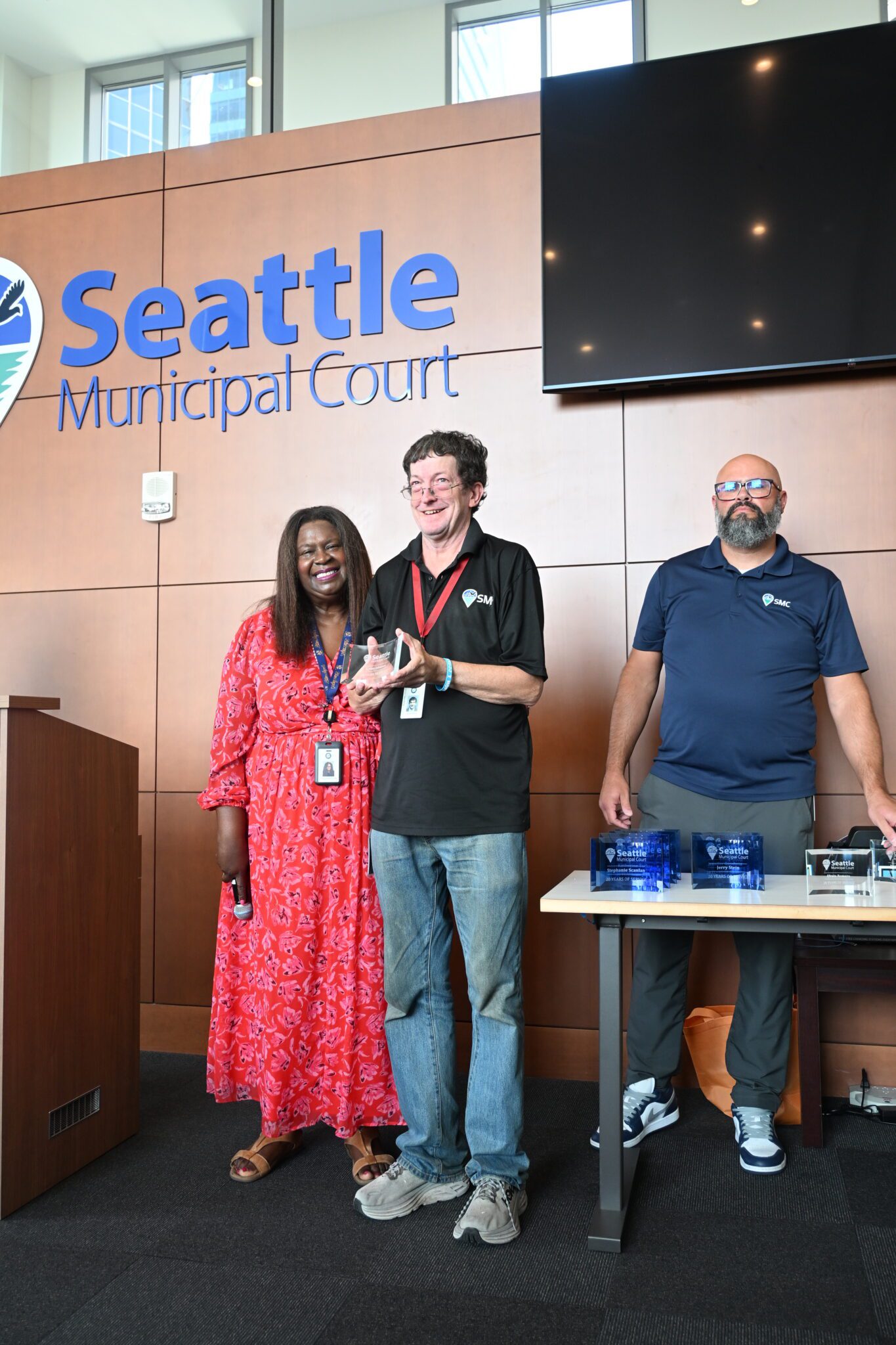
 Kevan Johnson (center) with Seattle Municipal Court Presiding Judge Anita Crawford-Willis and Court Administrator Josh Sattler at the court's annual Staff Appreciation event in August 2026. Johnson was honored for 30 years of service.
 This post is part six of the “From the Archives” blog series, a 12‑part exploration of how the Seattle Municipal Court’s (SMC) work, people, and spaces have evolved over time. This month, we turn our attention to the milestones that have shaped our community—moments of dedication, service, and continuity that mark the Court’s history.
Honoring employees is more than a gesture—it is a throughline that connects generations of public servants, shaping institutional culture and memory across decades. At Seattle Municipal Court (SMC), this tradition of recognition has evolved steadily, marked by the people who stayed, served, and built continuity within the SMC community.
Throughout the decades, SMC’s milestones have reflected the people who make up our institution: staff who have devoted years of service, teams who have grown and changed together, and traditions that remind us how interconnected our work truly is. These anniversaries and celebrations offer more than recognition; they serve as markers of shared progress and the collective effort behind the Court’s mission.
Employee recognition within the City of Seattle has deep roots. According to long‑time employee and HR professional Doran Young, the citywide tradition dates back since before her time. Young started her City of Seattle service in the late 1990s; and back then, the Mayor’s Office was in charge of formally recognizing milestone years of service—10, 20, 30, and 40-year anniversaries.
The events were large, with quarterly gatherings at Seattle City Hall where employees and their families were invited to celebrate accomplishments together. Young recalls that departments also had the discretion to honor employees for additional milestones—five, 15, 25, and beyond—typically through small, internally hosted events supported by managers themselves.
Though these citywide events were meaningful, they eventually faded. By around 2010 or 2011, the City stopped hosting them due to costs and low attendance. As Young noted, plaques purchased for honorees occasionally sat unclaimed, later stored in departmental file rooms. Even so, the spirit of recognition lived on in individual departments, including SMC.
Within the Court itself, employee recognition historically aligned with city timelines. For years, SMC’s participation largely meant acknowledging 10‑year service marks as part of the broader city program. That continuity mattered: long‑time employees came to expect that their service would be seen and appreciated, even if only through City channels.
But change came with new leadership and a renewed focus on workplace culture. HR Manager Aminah Long explained that when she joined the Court three years ago from a different City department, she recognized an opportunity to strengthen morale and build connection through creative, intentional recognition efforts—tailored specifically to SMC. Last year, her team introduced new employee awards focused on camaraderie, collaboration, and celebrating individual strengths. It marked the first time the Court moved beyond the city’s program to craft recognition that reflected SMC’s identity and values.
This year brought another significant milestone: for the first time, SMC formally separated Court-specific tenure recognition from the citywide years-of-service awards. Long shared that many employees had achieved 20 or more years at the Court itself—distinct from their total years with the City—and deserved recognition that honored that uniquely Court-centered service. Employees who reached 20 or more years at SMC received personalized plaques in addition to certificates, highlighting their loyalty and dedication to the institution they helped shape.
It’s no coincidence that these efforts emerged as many long-tenured employees approached retirement. In a workplace where some team members have served 30, 40, even 47 years, institutional memory is held not in policy manuals, but in people. One example is Lynn Malloy, who retired this past summer after an extraordinary 47 years at the Court. Her story exemplifies what it means to build continuity: decades of evolving roles, shifting procedures, and changes in leadership—all anchored by a commitment to showing up every day for the public and her colleagues.
Recognition is about honoring those stories. As Young noted, a historical review of Court practices from the early 2000s revealed that employees themselves viewed recognition as deeply important—important enough for the Court to dedicate budget and time to honoring service milestones. That sentiment remains just as true today. Staff appreciation events, anniversary celebrations, and tailored awards help employees feel connected to something larger than their job descriptions: they feel part of a legacy.
As SMC continues to grow and innovate, honoring Court employees—past, present, and future—remains one of its most meaningful traditions. It is an investment not only in people, but in the continuity of an institution built from decades of dedicated service.